

He wasn't looking for a buyer. He was looking for an army

BASED ON A CONVERSATION WITH LUCIANO ZINI
Luciano Zini started the way most installers start: on the tools, alone, taking whatever jobs would have him. No plan beyond the next contract. He trained young workers as he went, learned to read a blueprint before he learned to read a balance sheet, and built what is today Gruppo Zini one HVAC and hydraulics job at a time — Zini Impianti, its founding company, becoming one of the most respected specialist operators in its territory — close to €15 million in annual revenue, decades of trust with the same clients, a workforce that had grown up inside the company.
For thirty years, what kept Zini Impianti from taking its next step was never demand. It was arithmetic. To grow past a certain size, a specialist installer has to absorb more administrative weight, more project managers, more back-office structure, without that weight producing a single additional hour of work on site. ”The growth of a single company happens in steps,” Luciano told us. ”To take the next step, you have to increase your management costs without that meaning any increase in production. You’re paying more to carry more weight, not to do more work.”
This is the structural trap of the Italian installation sector: hundreds of excellent, fragmented specialists, each capped not by skill but by the cost of scaling alone. Luciano had seen it from the inside for years before he found his way past it. Finally, this June he joined Ventha Group, Koinos’ platform in the technical services space.
New equity stories from Koinos Capital, in the words of the founders who build them.
Ventha brings together specialist operators across every discipline an installation project actually needs: HVAC, electrical, photovoltaic, fire safety, insulation, building automation, engineering, without folding any of them into a single undifferentiated company. Each business keeps its name, its workforce, its founder at the helm. Today the federation looks like this:
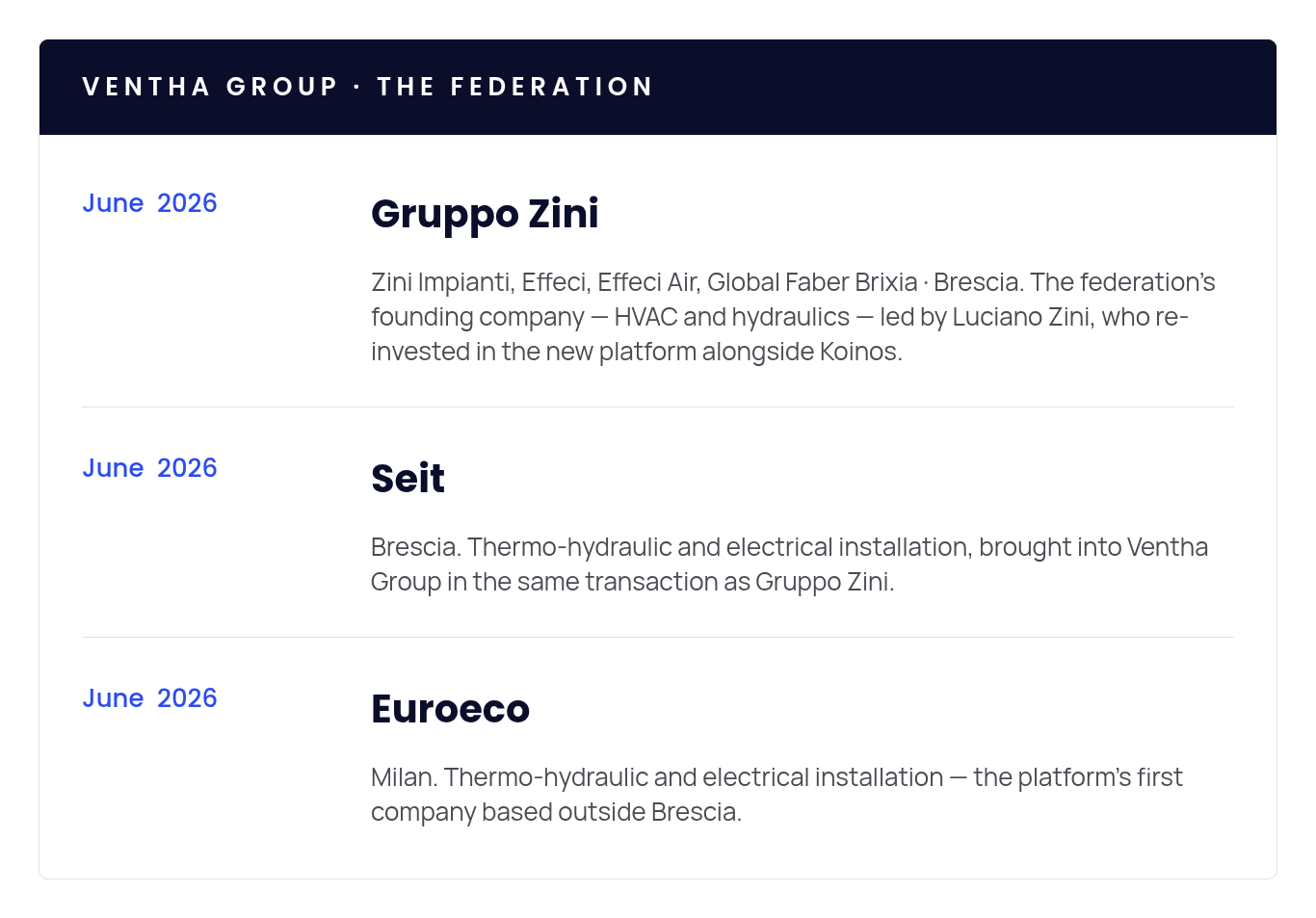
Three companies, one federation, brought together in a single transaction closed in June 2026: the first tiles of a platform now targeting €100 million in revenue within three years, in a national installation market worth roughly €26 billion.
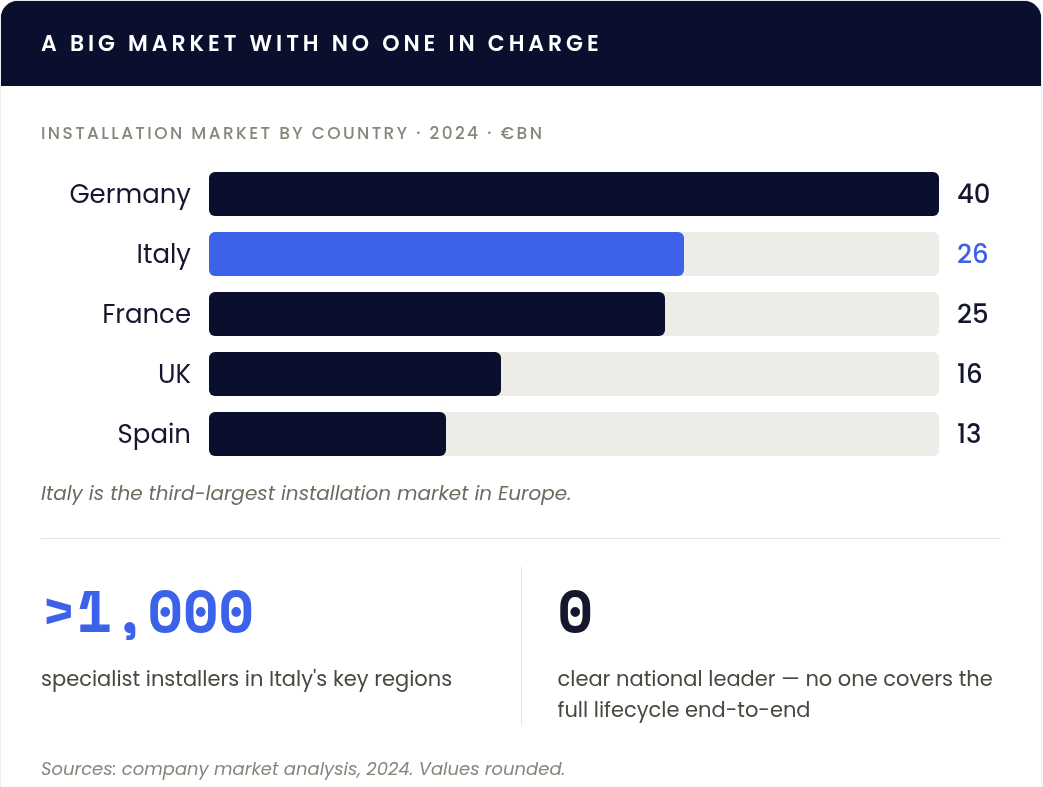
What changes is what they can do together, and Luciano explained it the way he has explained it to his own clients for thirty years: with a concrete example.
”When there is a tender for an installation project, the specification almost never covers just one category,” he said. ”Being part of the group, having acquired specialist companies across all of those categories, means the company that wins the commission can pull in the others, not as subcontractors that need to be marked up, but as partners inside the same family. The client gets one point of contact. The work gets done by genuine specialists. And the economic benefit of the whole commission is already shared, because the entrepreneurs are all shareholders in the same holding. You don’t need to put a margin on top of another margin.”
That last point is the one that matters most for the market Ventha is built for. Specialist operators have historically had two choices on large, multi-discipline contracts: subcontract for a general contractor who often lacks the technical depth to execute what it has sold, or stay small enough to handle only the work that fits inside one company’s own four walls. Ventha changes the equation. A company that wins the commission keeps the client relationship and the margin, and brings in the rest of the group as partners rather than vendors. Luciano has already run the model live, closing a €2 million contract for Zini Impianti and routing the electrical share, roughly €600,000 of it, to a fellow Ventha company, at full price, with the client’s full confidence. ”He told me: I know you’re part of a group now, and there’s a specialist company inside it I trust because you trust it,” Luciano said. ”He’d rather give the whole job to one name he trusts than split it himself.”
The urgency behind all of this is written into EU policy. Under the EU’s revised Energy Performance of Buildings Directive, buildings account for 40% of Europe’s energy consumption; the bloc has committed to zero-emission new construction by 2030 and a fully decarbonised building stock by 2050. Italy’s Superbonus programme, for all the capital it absorbed, renovated only a small fraction of the buildings that actually need it. ”The main driver is the energy transition,” Luciano told us. ”The EU has set binding targets, and they will continue to push, there is no alternative. And the energy companies themselves, the ones that are supposed to be selling clean energy, are realising they don’t have the specialist workforce to install the systems that would let them do it.”

Luciano Zini has watched the energy transition shift happen inside his own order book. In the last four years, Zini Impianti has not completed a single new installation running on gas or fossil fuel: everything is heat pumps, electric systems, LED retrofits, photovoltaic. And as the technology changed, so did the economics underneath it. ”In 2010, a standard 100-square-metre apartment required around €10,000 in total mechanical and electrical installation,” he said. ”Today, the mechanical system alone costs €30,000+. Add the electrical and you are at €50,000 or more. Roughly six times what it was. Not because of inflation — because the systems are categorically more complex. The renovation of a space today costs more in systems than it costs in brickwork, plastering, and finishes combined. Companies from fifteen years ago turned over thirty million with six or seven times the workforce I have. Not because they were less capable, but because the installation was worth less then.”
Given all of that, the obvious question is why Luciano Zini didn’t simply sell. Plenty of buyers would have written the check. He didn’t, he says. ”I would never have sold just to sell,” he told us. ”I believe that our companies, inside this federation, will be worth more.” He was direct about what Koinos is actually buying: not revenue, but the reliability and the entrepreneur underneath it. “The workforce, the client relationships, the specialisation, those are what matter. You cannot manufacture those.”
What he gave up was not control. He is still at the helm of Zini Impianti; his team is unchanged; his clients are unchanged. What he gained, in his own words, was ”a resource”, one that has let him spend more time being an entrepreneur and less time on the financial, legal, and administrative load that used to sit entirely on his desk.
That load is exactly where Koinos’s first concrete contribution landed: the appointment of Ventha’s first shared CFO, giving every founder in the group something none of them had built alone: real-time margin visibility by commission, a backlog view, the management control tools that used to live, as Luciano put it, ”in the entrepreneur’s head” alone. In a business where institutional knowledge has historically been a single person’s memory, that changes what the company can do next.
If another installation entrepreneur recognised himself in everything Luciano described: capped growth, margins thinned by general contractors, the struggle to find and keep skilled tradespeople in a market where they’re increasingly scarce, his answer was direct. ”If you are part of a group, the difficulties are no longer yours alone, they belong to everyone,” he said. ”Everyone has an interest in helping each other. You are not alone anymore. I prefer to fight a war in a large army.”
Ventha Group today counts over 100 professionals and technicians, combined revenues of approximately €22 million, and EBITDA approaching €4 million. The three-year target is €100 million, built through the continued acquisition of specialist operators across every technical discipline the market needs. For entrepreneurs weighing the same choice Luciano Zini faced, his answer is unambiguous: the companies that join this federation will be worth more inside it than they ever were alone.
If you're an installer thinking about your next step, talk to us before you decide to do it alone. Reach out at www.koinoscapital.com
New equity stories from Koinos Capital, in the words of the founders who build them.